Lately, it feels like everyone is talking about “toxic” behavior — from friendships and relationships to online interactions. And honestly, at first, I thought this wave of awareness was going to bring some much-needed change. I even wrote a piece not too long ago about recognizing harmful relationships and protecting your peace.
But recently, I’ve noticed something new. It seems like the word toxic has started to lose its meaning. Suddenly, any disagreement or minor frustration is being labeled as toxic — when sometimes, it’s really just a misunderstanding or a lack of communication.
Let me give you an example. If I called up my best friend to vent about how my fiancé never seems to buy coffee, I could easily spiral into labeling that behavior as unfair or even toxic. But if I’m honest with myself, I’ve never actually told him how I feel about it. Maybe he doesn’t even realize it’s bothering me. Maybe he’s covering other expenses I haven’t thought about. Before I label the situation, I owe it to us both to communicate.
And that’s the thing — calling everything toxic can stop us from doing the hard, but necessary, work of understanding and growing with the people we love.
💭 What Actually Makes a Relationship Toxic
Now, that doesn’t mean true toxicity doesn’t exist — it absolutely does. There are patterns of behavior that cross the line and can chip away at your peace and self-worth.
Here are a few examples of what toxic behavior can look like:
✨ They continuously ignore or dismiss important issues that matter to you. ✨ They use personal things you’ve shared against you later. ✨ They intentionally do something hurtful, then twist it to make you the problem. ✨ They never take accountability — it’s always your fault. ✨ They show little empathy, yet expect endless compassion from others. ✨ They can’t stand being told they’re wrong. ✨ Their apologies feel fake, condescending, or manipulative. ✨ When you express your feelings, they lash out and blame you for “starting drama.”
None of us are perfect — we all have moments where we’re selfish, defensive, or just not our best selves. But there’s a huge difference between someone who listens, reflects, and wants to grow versus someone who refuses to take responsibility.
For instance, if your partner needs time to cool off before having a hard conversation, that can be healthy. But if they constantly delay or avoid the talk because they don’t care or don’t value your needs, that’s when it becomes toxic.
🔥 The Candle Example There’s a viral video that perfectly sums up a dynamic known as reactive abuse — when the real aggressor provokes someone, then plays the victim once the other person reacts.
In the clip, a little girl smugly blows out her sister’s birthday candles. Naturally, the younger sister gets upset — and guess who gets scolded? The little sister. It’s a lighthearted example, sure, but it highlights something real: the way manipulative behavior can shift blame and make the person reacting look like the problem.
At the end of the day, communication is everything. If something doesn’t feel right, don’t brush it aside. Talk it out, set boundaries, and trust your intuition. Healthy relationships — whether romantic, platonic, or family — are built on empathy, accountability, and effort from both sides.
It’s okay to call out truly harmful behavior, but let’s also leave space for growth, grace, and understanding. Because not everything that’s uncomfortable is toxic — sometimes it’s just human.
Now that I’ve told you about that one high school disaster, I have to tell you about the other one — because of course there’s more than one.Looking back, this embarrassing high school moment was about more than awkwardness — it was my first real lesson in power, trust, and who schools choose to protect.
I was reminded of this whole saga recently while catching up with one of my closest childhood friends at our annual Christmas meetup. We always slip into reminiscing mode: childhood memories, inside jokes, and yes… the high school stories that make us cringe and laugh at the same time.
Cheer Tryouts at 6 AM (Because Why Not?)
Picture 14-year-old me: excited, hopeful, and trying out for cheerleading. The tryouts were held before school at 6 AM. And being 14, I did not think to bring an extra outfit or shower supplies. So I went straight to class feeling… let’s say “less than fresh.”
Facepalm doesn’t even begin to cover it.
My first class of the day was jewelry art with a few close friends. I kept joking about how gross I felt and even made a ridiculous comment about rubbing my friend’s Pepsi on me to mask the smell. Why Pepsi? I truly don’t know — but at the time, it felt hilarious in that “we’re young and delirious” high school way.
My friends reassured me that I didn’t smell, told me everything was fine, and we carried on like normal. At least… I thought we did.
The Mysterious Escort to the Office
The day continued until English class. As I approached the door, I saw my teacher standing beside a woman I didn’t recognize — possibly a secretary? Before I could even cross the threshold, the secretary stopped me:
“You need to come to the office.”
And me? Being the cheerful, naive little freshman I was, I responded, “Oh! Sure, I can!” with a literal skip in my step. I had absolutely no idea what was about to happen.
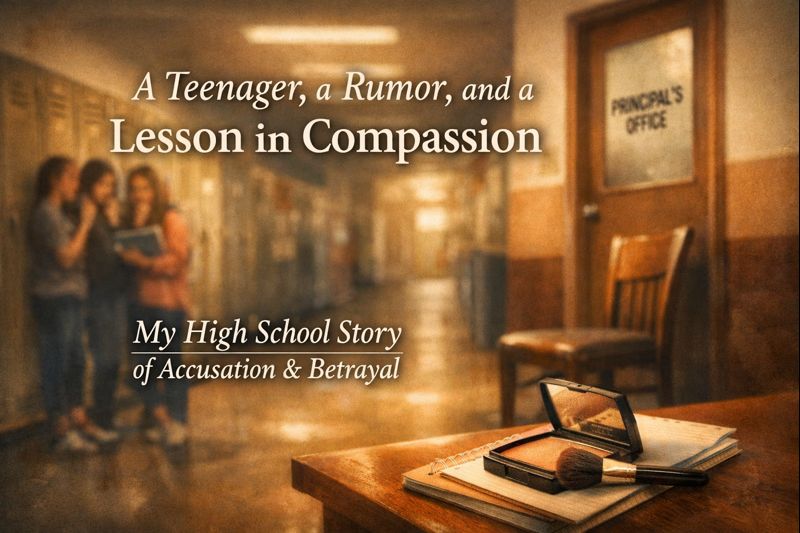
I was seated in a chair outside an office, tucked in a hallway past the lobby. With a few minutes to kill, I pulled out my bronzer compact and touched up my makeup like I was backstage at America’s Next Top Model. Tyra Banks and Snooki would’ve been so proud. Present-day me cringes at the memory!
The Interrogation Begins
A blonde woman eventually appeared and led me into an office. I chirped a friendly “Hello!” because… well, I was 14 and friendly.
She was not.
“Elizabeth.” Cold. Flat. Disapproving.
Then, after clearing her throat, her voice dropped an octave: “Elizabeth, have you been doing something you shouldn’t?”
I froze. I didn’t know who she was, why I was here, or what on earth she was implying. I stammered, “No… I don’t think so. What do you mean?”
She stared at me blankly before snapping, “You know what I mean!”
I felt fear and anger rising in my chest. Tears welled in my eyes — which only made things worse. She mocked me:
“Oh wow. You’re quite emotional, aren’t you? Why are you so emotional?”
Her tone, her expression… everything about her said she had already judged me. Already decided who I was. I felt completely trapped.
She stormed out, demanding to know “what I was even doing out there,” and the secretary casually replied, “She was just sitting out here doing her makeup like it was nothing.”
My bronzer compact suddenly felt like Exhibit A in a crime I did not commit.
Panicked, I texted my brother on my little flip phone: “They think I’ve been doing something!! What do I do????” He, unfortunately, was asleep.
Enter: The Vice Principal
The blonde woman returned with the Vice Principal, a man who had already creeped out most of the student body. Rumors had swirled after a shirtless photo of him (tribal tattoo and all) circulated around school, followed by whispers of inappropriate behavior with female students.
This did not help my anxiety.
“We’re going to have to breathalyze you,” he said sternly.
I was literally shaking as I blew into the tube. Of course, it showed I hadn’t been drinking — I was the most straight-laced kid at this time. I didn’t even think drinking was an option for me.
But the humiliation was already done.
Next, they dragged me down the hallway to search my locker. If they were looking for lip gloss and Twilight novels, they would have struck gold. But alcohol? Obviously not.
They found nothing and finally sent me off to class, shaken and humiliated.
So What Actually Happened?
The administration didn’t even call my parents. They didn’t try to understand. They didn’t care.
But they did email the cheerleading coach to report “an incident.”
It turns out a group of senior girls from my jewelry art class had overheard my silly comments about smelling gross. Instead of minding their own business, they drew a map of the art room, put an X where I sat, and reported — in writing — that I had been drinking.
I thought their staring earlier was because I actually smelled. But no. They were taking notes like undercover agents in the world’s most pointless sting operation.
One of those girls is now a police officer, and while I hope she’s grown since high school… I can’t help but worry about discrimination and abuse of power when I remember how casually they lied about me. Even after it was proven false, they kept bragging that they “got me in trouble.” I ran into her years later and asked her about this ordeal and why it happened. She blamed another girl and said it was because she could.
Why This Matters: A Lesson in Power andAccountability
There’s one more part of this story that sticks with me — maybe the part that matters most.
Not long after everything happened, the principal called me into his office. He told me there wouldn’t be any disciplinary action taken against the girls who accused me. Then he asked, gently but pointedly, if that would upset me… if I planned to hold any grudges.
And I lied.
I smiled. I said no. I said it was fine.
But what was really going through my head was something like, Oh. I see what’s happening here. I understood, even at fourteen, that the adults in charge were protecting themselves and the system — not me.
I left that office furious.
Our school motto was “AMES HI AIMS HIGH.” It was painted everywhere — hallways, assemblies, pep talks. And after this, it felt disgusting to me. Not because aiming high is bad, but because it wasn’t real. It wasn’t for everyone. It was for certain students, certain families, certain narratives they wanted to protect.
Looking back, I can trace a line from that moment forward. Over the next few years, I was called into that same office again and again for tardiness. I could never seem to be on time. I was truly something back then — scattered, angry, quietly rebellious in ways I didn’t yet have words for.
If I had to pick a starting point for where that “something” began — the distrust, the edge, the inability to care the way I once did — it was here.
This wasn’t just about an embarrassing misunderstanding or teenage drama. It was about being falsely accused, humiliated, and then told — politely — to swallow it. To be agreeable. To move on without accountability.
That’s why this story still lives rent-free in my brain all these years later.
Because when adults dismiss harm instead of addressing it, kids internalize that lesson. We learn when the truth matters — and when it doesn’t. We learn who is protected and who is expendable. And sometimes, we carry that knowledge with us far longer than anyone expects.
The Aftermath
This whole ordeal shattered my trust in my high school’s administration. I was a naive, emotional freshman who made one silly comment about body odor — and suddenly, adults were breathalyzing me, mocking me, and treating me like a drunk idiot.
I truly hope schools handle situations like this differently today.
High school feels huge when you’re in it, but in the grand scheme of life, it’s just a small chapter — even if some moments stick with us forever. Some stories fade with time. Others shape who we become — whether anyone ever apologized or not.
Do you have any stories from high school that still make you cringe, laugh, or both? Share them below — I’d love to hear them.


 Cupcakes & Tea with Elizabeth